
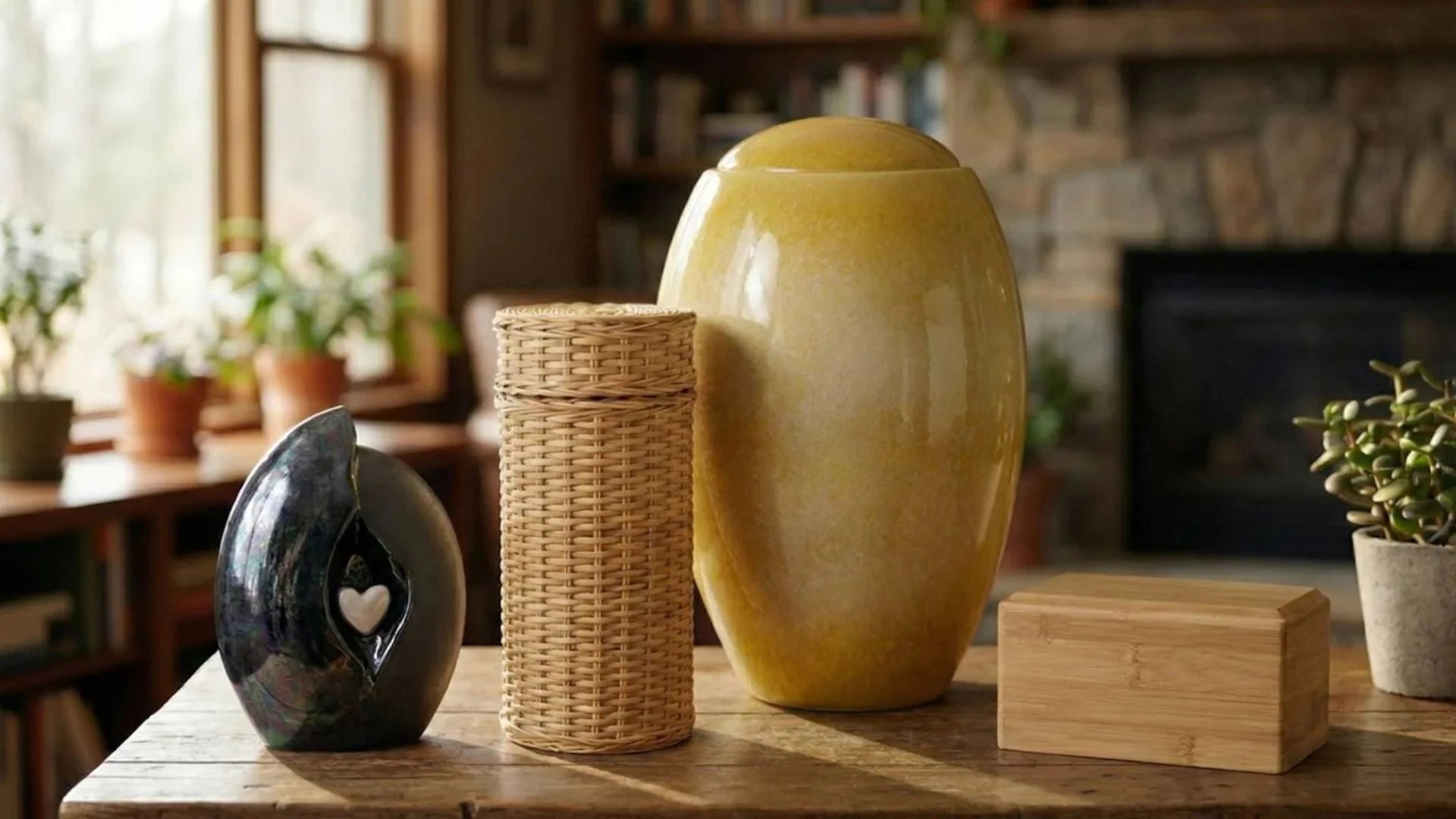
The material of a cremation urn affects more than its appearance. It influences how the urn feels when lifted, where it can be placed, how its surface should be cared for, and which kinds of personalization are possible. A rich wood grain may feel right for one home, while a smooth metal finish suits another. The useful question is which material supports the family’s intended use and preferred style.
Begin with the destination. An urn that will remain on a protected indoor shelf faces different conditions from one being placed in a cemetery or transported between homes. Once that destination is understood, compare the construction, finish, opening, weight, and care instructions of individual products. Broad material labels help organize the search, but they do not tell the whole story about a particular piece.
Match the material to the setting
Think about the environment before ranking materials. Will the urn stand in a living room, sit inside a cabinet, or be enclosed in a cemetery niche? Will someone need to lift it regularly? Does the household include pets or young children who could reach the display? These practical questions are more useful than choosing a material because it sounds prestigious or unusually durable.
Urns can be compared more clearly when the family has already identified the intended location and the qualities it values. Make a short list of essentials, such as a wide base, a specific height limit, or a surface that requires little attention. Then use color and decoration to choose among the products that satisfy those requirements.
Keep indoor display and outdoor suitability separate. A material that appears strong is not automatically suitable for rain, frost, direct sunlight, or contact with soil. Finish, joints, adhesives, fittings, and closure design also matter. If outdoor use or burial is planned, ask the manufacturer and receiving cemetery about the exact product instead of drawing a conclusion from the word “metal” or “stone.”
What to look for in a wood urn
Wood offers grain, tonal variation, and a familiar furniture-like appearance. A simple wooden box can sit comfortably beside photographs and books without demanding a formal display. Carving or engraving can add a landscape, symbol, or name while keeping the overall design restrained. For a person associated with woodworking, a favorite cabin, or time spent outdoors, the material may carry a personal connection.
Read the construction description carefully. Solid wood, wood veneer, and composite construction describe different products, even when their photographs look similar. None should be evaluated solely by a marketing adjective. Ask which parts use the named wood, how the exterior is finished, and where the access panel sits. A well explained product is easier to compare than one described only as luxurious or handcrafted.
Because wood surfaces and finishes can respond to their environment, a sheltered indoor location is a sensible starting point unless the maker specifies another use. Avoid assuming a household furniture treatment is appropriate for every finish. Request the product’s care directions, particularly if the urn includes painted details, inlay, engraving, or an attached plaque. The care routine should suit the actual construction.
What to look for in a metal urn
Metal designs range from understated brushed surfaces to polished, painted, or patterned finishes. Their shape can be traditional or contemporary, so the material does not dictate a single style. When comparing products, identify the base metal and the surface treatment. An aluminum urn with a decorative coating and a brass urn with a polished finish may need different care despite sharing a similar color.
Pay attention to the lid and base. Ask how the closure works, whether the maker provides sealing instructions, and whether the underside protects the furniture surface. A smooth looking photograph may not reveal a raised rim, exposed fitting, or narrow contact area. If the urn will sit on delicate furniture, confirm whether the manufacturer recommends a separate protective layer beneath it.
Do not assume that every metal urn is convenient for air travel. Screening depends on whether officers can obtain an acceptable view of the contents, along with the airline’s requirements. A family planning a flight should verify the exact container with the relevant authorities and carrier. It may be more practical to use a suitable travel container and place the remains in the chosen display urn after arrival.
What to look for in a ceramic urn
Ceramic designs can offer soft curves, distinctive glazes, and colors that are difficult to reproduce in other materials. Some have a quiet, sculptural appearance; others feature painted motifs or an artisanal surface. If visual individuality matters to the family, ask whether the product shown is the exact item being sold or an example of a design with natural variations.
The placement should account for the possibility of breakage if the urn is dropped or struck. A sheltered cabinet or stable surface away from routine traffic may be preferable to a narrow ledge. Consider how the item will be carried during cleaning, a move, or a memorial gathering. A heavier piece with a smooth glazed surface can require more deliberate handling than its appearance suggests.
Ask how the lid is secured and whether the maker supplies a storage or transport box. Decorative lids may look integrated with the body while using different closure methods. The family should understand the mechanism before the urn is filled. If the product has delicate handles or projecting ornaments, ask whether they are decorative and avoid using them as lifting points without explicit instructions.
What to look for in a stone urn
Stone and stone-like products can create a substantial visual presence. Veining, mottling, and variations in color may make each piece look different. However, descriptions such as marble, cultured marble, natural stone, and stone composite are not interchangeable. Ask for a precise material description and, when appearance is especially important, a photograph of the actual item or a clear explanation of expected variation.
Weight deserves attention before purchase. Check the empty weight as well as the intended placement surface, and remember that the filled urn will weigh more. A fragile glass shelf or furniture piece of uncertain strength may not be appropriate. Choose a location that supports the object securely and allows it to be moved with both hands without reaching overhead or twisting awkwardly.
Surface care should follow the maker’s advice. Avoid selecting cleaning products simply because they are marketed for household stone; the urn may have a coating, engraving treatment, or attached component that needs different handling. A protected location and a minimal approved cleaning routine are usually easier to maintain than a display that exposes the surface to spills, plant watering, or candle wax.
Compare construction before judging value
The same material can appear at several price levels because products differ in size, workmanship, decoration, finish, packaging, and personalization. Compare those features directly. A higher price does not resolve a missing capacity specification, and a lower price does not necessarily indicate that an urn is unsuitable. The meaningful comparison is between products that meet the same practical requirements.
Look closely at the base, seams, access panel, and closure. Request additional photographs if the listing shows only a front view. Ask whether engraving is performed directly on the urn or on a separate plate, whether it changes the return policy, and whether the quoted price includes the selected size. These details often explain the difference between superficially similar products more clearly than descriptive language does.
Check what is included in the package. A protective bag, presentation box, small keepsake, or engraving service may be useful, but only if the family wants it. Record the total cost after shipping and any chosen customization. Avoid letting an included accessory outweigh a more important issue, such as an uncertain opening size or a finish that does not suit the intended location.
Use a sample arrangement to make the decision
If two materials remain equally appealing, imagine each in the actual setting. Place a wood object and a metal or ceramic object of roughly similar scale on the intended surface. Observe them in daylight and in the room’s evening lighting. This is not a test of the urn itself, but it can reveal whether the family prefers a warm, textured presence or a smoother, quieter shape.
Include nearby objects in the exercise. A patterned urn may compete with a detailed photograph frame, while a simple design can leave more room for other personal items. Conversely, a richly carved urn may be the only decoration the display needs. Choosing fewer surrounding objects can make a meaningful design easier to appreciate and the surface easier to keep clean.
When relatives have different tastes, separate practical requirements from personal preferences. Everyone may agree on the size, stability, and location even if they favor different colors. Decide whose home will hold the urn and how other family members can participate through a photograph, keepsake, or shared memorial record. A main urn does not need to represent every person’s decorating preferences at once.
Choose a material the family can live with
The final choice should be comfortable in everyday use. Consider who will care for it, whether they can lift it safely, how much maintenance they want to perform, and whether the location may change. Keep the manufacturer’s instructions and the product description with the receipt. Those details become particularly useful if another relative later takes responsibility for the urn.
Wood, metal, ceramic, and stone can each support a thoughtful memorial when the individual product fits the setting. Compare what can be verified: capacity, dimensions, construction, closure, weight, finish, and care. Then allow personal meaning to guide the remaining choice. A material associated with a loved one’s home, interests, or style can provide a lasting connection without requiring elaborate decoration or an unnecessarily expensive purchase.